Sword Stained with Royal Blood: The Peerless Statesman Yuan Chonghuan
YoungForest · https://youngforest.github.io/en/2023/08/20/Yuan-Chong-Huan/
Douban link: Sword Stained with Royal Blood
The novel itself is a 6/10, but the appended “A Critical Biography of Yuan Chonghuan” is extremely good. It has history, as well as Jin Yong’s own commentary. Most importantly, many of its views on the fall of the Ming align with mine. It is worth 10/10. I had so many thoughts that a short review could not hold them, so I wrote a very long book review.
Yuan Chonghuan was truly a peerless statesman. The Ming-Qing transition was China’s last dynastic change under the feudal monarchy system. Because it happened relatively recently, records and historical memory are quite clear. And because multiple forces were competing, the drama was intense. The ending was that the Manchus entered the Central Plains and established 268 years of rule over China proper. It ended as an even greater tragedy, making it all the more regrettable and infuriating. The year 1644 was the first year of Shunzhi, the seventeenth year of Chongzhen, and the first year of Yongchang. I am grateful to Jin Yong for using this background to write this wuxia novel. This novel also connects several of Jin Yong’s other works, such as The Deer and the Cauldron; characters including Jiu Nan, Gui Xinshu, and Feng Nandi all appear.
My earliest exposure to this period of history was through various Qing palace dramas I watched as a child, such as The Secret History of Xiaozhuang. Later, in college, I read Dangnian Mingyue’s Those Things in the Ming Dynasty, which gave me a relatively detailed understanding of this period. Regarding the tragic history of the late Ming, Dangnian Mingyue can be said to have been reluctant to write too much. In particular, as a civil servant, whether intentionally or not, he was good at using the “Spring and Autumn brushwork”: glorifying Ming emperors and covering up their faults, especially Emperor Yingzong and Emperor Chongzhen. After finishing it, I somehow felt that “my ministers have misled me” made sense, and that the reason the Ming fell was simply that “the Great Ming’s fate” had run out. Many changes were left unexplained. For example, from Tianqi to Chongzhen, it suddenly went from upright officials filling the court to eunuch-party domination; even after the eunuch party was destroyed, the entire bureaucracy still became deeply corrupt.
Only after I later encountered more literary works and criticism did I understand how Dangnian Mingyue’s books concealed and distorted historical truth. Examples include Ming Dynasty in 1566 and Ma Boyong’s The Two Capitals: Fifteen Days. In the afterword to Sword Stained with Royal Blood, Jin Yong also took great pains to write about Yuan Chonghuan and the truth of the late Ming. This is a rare amount of space in his wuxia novels, taking up about 10% of the whole book. He was probably afraid that readers would not understand the history of that time. I am very grateful for it.
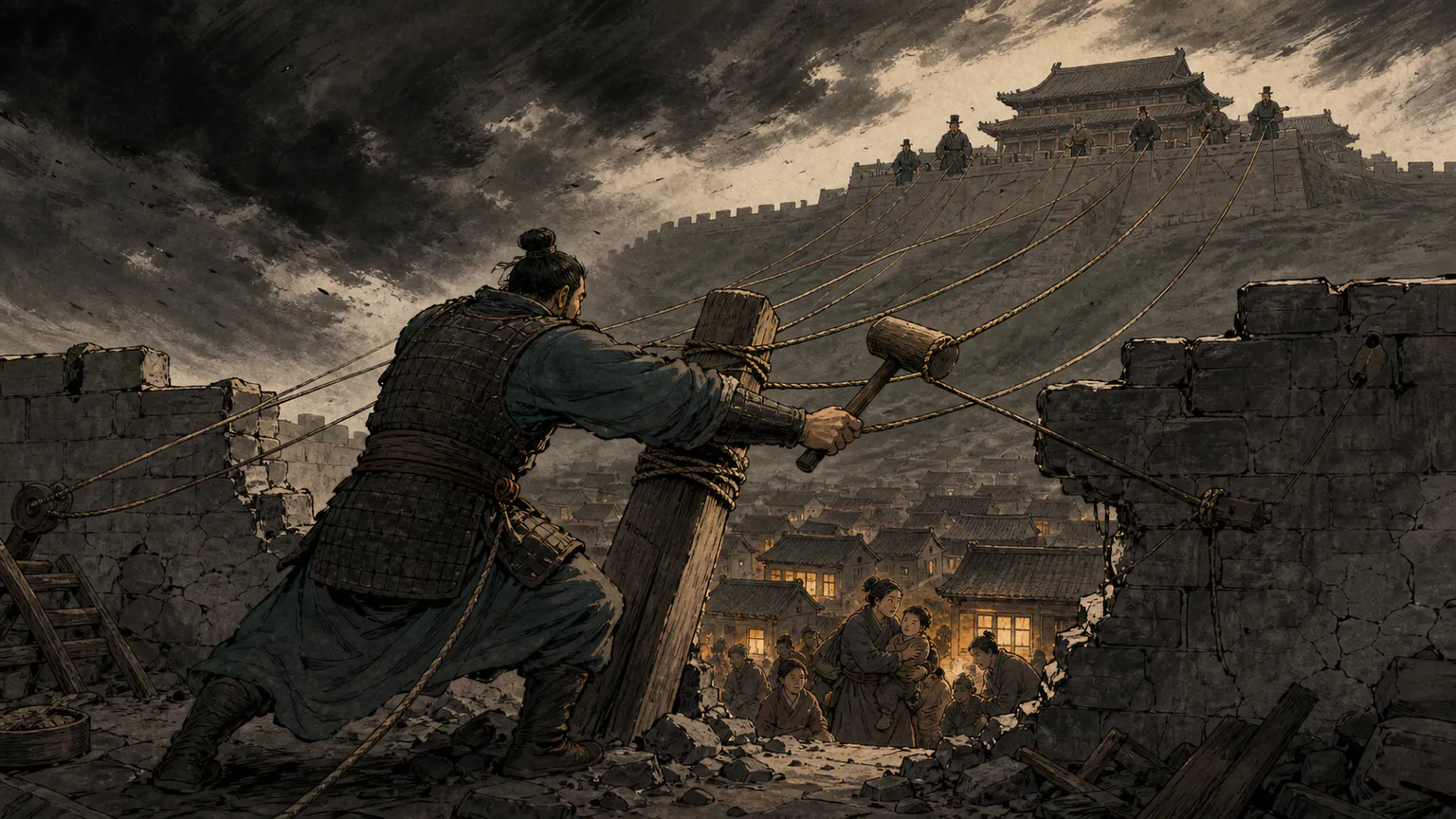
The biggest reason for the fall of the Ming was the system. Since the Qin dynasty, the overall trend in China was the continuous strengthening of monarchical centralization. An autocratic system has many flaws: power is the foundation, officials are responsible upward rather than downward, and institutions constrain one another, resulting in low efficiency. In the late Ming specifically, border officials were restrained from multiple sides and forced to do many things they did not want to do. Yuan Chonghuan was inexplicably forced by Gao Di to abandon the 200-li defense line east of Ningyuan. Sun Chuanting was forced by Chongzhen to leave Shanxi and fight the rebel army in Henan. Military generals were constrained by civil officials who knew nothing about military affairs; and even when civil officials who understood military affairs and were loyal took charge, such as Xiong Tingbi, Sun Chengzong, Yuan Chonghuan, and Sun Chuanting, they were still constrained by court officials and eunuchs and could not realize their ambitions. It feels much like today’s saying, “If I cannot handle the enemy, can I still not handle you?” Just as Huang Yanpei asked, “How can we escape the historical cycle of rise and fall?” Mao Zedong answered, “By implementing democracy and letting the people supervise the government.” Democracy originated in Athens, Greece, developed into modern democracy during the French Enlightenment, and eventually became a mainstream value of human civilization. Today, in the 21st century, even autocratic regimes have to brand themselves with “democracy and freedom.” Of course, 400 years ago, Chinese people were limited by their historical conditions and could not have achieved this no matter what. But Chinese people today should no longer fail to understand it.
The second reason was the emperors: Wanli, Taichang, Tianqi, and Chongzhen. Especially Chongzhen, who could not distinguish loyal officials from traitors and was stubbornly self-willed. Although in the end the ruler died with his state, he still did not understand, saying things like “my ministers have misled me” to shift responsibility. Although loyal and capable officials were few, there were still some, and he drove them away, drove them to death, or even directly executed them. In such an environment, bad money naturally drove out good, and the ones who remained in the end were traitors and cowards.
Only after that comes officials’ factionalism and corruption. But this did not begin with Chongzhen or Wanli. It began at the founding of the dynasty under Hongwu, then continuously developed and worsened until it became an incurable disease. Ultimately, it was still because of the system. Human nature is selfish; under an autocratic system, every interest group only seeks benefits for itself. Power is the root of benefits, which means people are responsible to the source of power. The final result is deceiving both superiors and subordinates. Internal supervision within the system is useless, whether in the past or today. This is why China has repeatedly talked about “political system reform” before.
Wen Qing, the heroine, really resembles my ex-girlfriend in personality. Because of her family of origin, her emotions were extremely unstable; in more scientific terms, it was “borderline personality disorder” and ADHD. So although many readers may not be able to stand her, I can still understand the heroine. During the three years I spent with my ex, I used my own love to tolerate her and help her grow a lot in both personality and studies/career. Although she was indeed difficult to get along with, I also gave it everything I had. In the end, although we separated, seeing Yuan Chengzhi and Wen Qing love each other and enjoy peace overseas counts as a bit of comfort.
As the male protagonist, Yuan Chengzhi may not be handsome, but he is the descendant of a military family, highly skilled in martial arts, and full of chivalric spirit, winning the affection of several women. A’jiu’s deep devotion in particular is truly hard to let go of. After learning about her elder brother and Sister Qing, A’jiu chooses to become a nun to fulfill their relationship. That is truly generous. Through Yuan Chengzhi’s perspective, Jin Yong strings together historical events from the middle and late Chongzhen era, expressing what he believed were the reasons for the fall of the country and for King Chuang’s failure. The scenes of chaos and suffering in the late Ming are especially heartbreaking. Rulers and ruling classes constantly claim to love the people; King Chuang and Hong Taiji did the same. But what they actually did was harm the people. As expected: when states rise, the people suffer; when states fall, the people suffer. The people still have to stand up by themselves, not by electing someone to be emperor, but by using democratic institutions to truly place power inside the cage of institutions. Power should belong to the people, not to an individual or a small group.