The Gains and Losses of Economic Changes in the Past Dynasties
YoungForest · https://youngforest.github.io/en/2024/01/29/The-gains-and-losses-of-economic-changes-in-the-past-dynasties/
The best book I read this year, the one that resonated with me most and inspired the most thinking. Strongly recommended. I have many thoughts and feelings I want to share, but it is hard to judge the boundary. So bold, so brave. It summarizes economic reforms from ancient times to today, especially the six rounds of “the state advances while the private sector retreats” after the modern era. It contains many thoughts and many awakening golden lines. Although it seems to intentionally ignore Zhang Juzheng’s reform, the flaws do not obscure the merits.
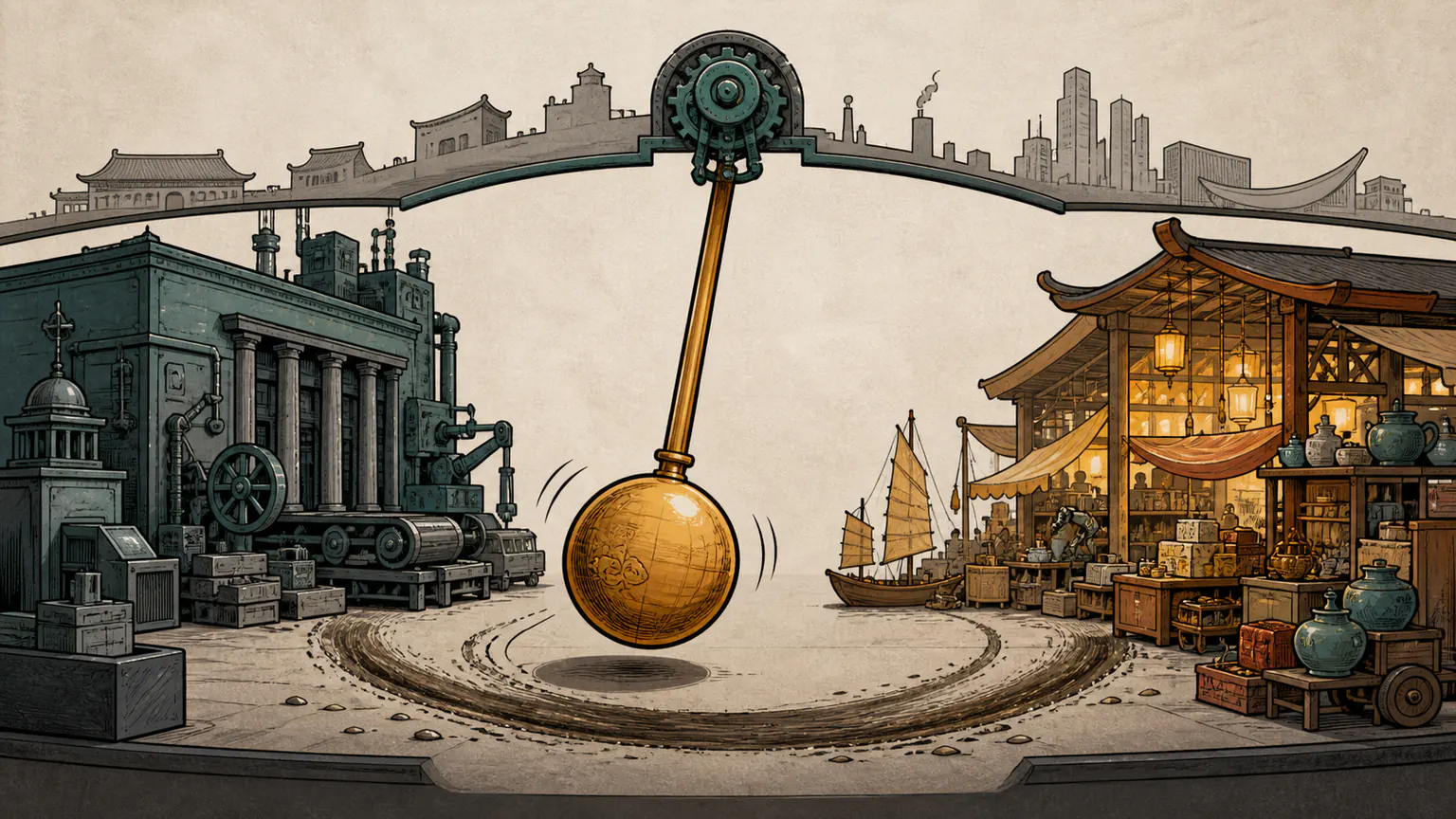
Economic reforms under centralization are bound to compete with the people for profit, aiming at a rich state, strong military, and stable rule, but in the long run they instead lead to collusion between officials and merchants and to popular uprisings everywhere. Liberalism, rule of law, protection of private property, the bourgeoisie, and technological progress are the long-term solution, especially for the country and the people. The root of economic reform is still political reform. Without supporting institutions, economic reform cannot be thorough, and achievements already obtained will be lost. This book was written in 2013, so it did not cover what happened afterward. The reforms after 2013 were the seventh round of “the state advances while the private sector retreats” in modern Chinese history. The landmark events were the renewed rise of state-owned enterprises and central SOEs, and stronger control over private capitalists. In 2020, blocking Ant’s IPO opened the prelude to restricting the “disorderly expansion of capital.” Again, it used common prosperity as the excuse. We have all seen the final result: when one whale falls, everything dies.
In the afterword, Wu Xiaobo mentions four unprecedented new forces: the internet, NGOs, entrepreneurs, and liberal intellectuals. He placed great hope in them to promote economic reform and institutional change. Ten years later, these four forces had basically vanished.
Some passages I really like are incisive and worth savoring repeatedly:
Without studying economic changes across dynasties, one cannot truly understand today’s China.
In this world, human greed requires an institutional foundation. Good institutions restrain human evil; bad institutions catalyze and magnify it. In this sense, more frightening than human greed is institutional greed. The famously upright official Wang Anshi created a greedy centralized system. His successors would push this greed and centralization to the extreme, inevitably producing alienation. This is an “inertial path.”
The two events that occurred in Wang Anshi’s era had watershed significance. Free cities gave birth to free commerce; free universities gave birth to free thought; and free commerce and free thought were the two cornerstones for human civilization entering modern society.
Ming and Qing rulers had especially developed “despotic wisdom.” They truly discovered the “secret of despotism”: if a regime wants stability, danger comes from only two places: external troubles and internal worries. To eliminate external troubles, cutting off all connections is the only method, so the country must be turned into an iron barrel. To resolve internal worries, the key is to control and weaken the organizational power of civil society, so the people must be beaten into scattered sand.
The iron-barrel formation and scattered-sand technique were the two great magic weapons of Ming and Qing rulers.
The French thinker Tocqueville once said: “The most dangerous moment for a bad government is usually when it begins to reform.”
Hayek began with The Fatal Conceit and ended with The Road to Serfdom.
The government below refers to the Nanjing Nationalist Government of the Republic of China.
The private entrepreneur class was completely disappointed with the government. Rong Desheng, then the controller of the largest private group, submitted a letter to the government. He wrote: “If we discuss the national economy, the rulers possess all under heaven. They only need to hold political power, let the people live and work in peace and prosperity, let people’s livelihood be abundant, and tax revenue will be sufficient… If the people’s power can be used, there is no need for state operation, and state expenses will be sufficient. If the people’s power cannot be used, even if everything is made official-run, it is useless. Officials come from the people. When matters do not concern themselves personally, they only add waste.” Rong Desheng’s statement is remarkable and remains a universal truth today, sadly unheard by those in power.
The main themes of Chinese economic reforms across dynasties:
First, the principle of grand unity: maintaining national unity and centralization.
Second, the principle of national strength: resisting foreign enemies and strengthening the state.
Third, the priority principle of state-owned economy: developing state-run enterprises and restraining private capital.
The four major interest groups in Chinese economic reforms across dynasties:
Central government and local governments.
The propertyless class and the property-owning class.
So bold, so brave. It even wrote about economic reforms from 1949 to 1978.
During the entire planned-economy period, peasants were a betrayed and deprived class. They lost their land and were deprived of the right to enter cities. The wealth they created was transformed into state assets through the “price scissors,” while their living quality did not improve correspondingly.
By 1976, China was a closed and self-isolated economy, basically “insulated” from the world economic system, highly concentrated and without vitality. Borrowing Sima Guang’s evaluation of Emperor Wu of Han, the rulers at that time “had the faults of fallen Qin, yet avoided Qin’s disaster.”
Evaluation of reform and opening:
Over nearly thirty years, Deng Xiaoping’s words formed a powerful social consensus, thereby outlining several basic characteristics of this reform: utilitarian and pragmatic, passive and gradual, unbalanced, and incomplete.
The French Enlightenment thinker Montesquieu once said: “The smallness of a land’s output lies mainly not in the fertility of the soil, but in whether the inhabitants enjoy freedom.”
This book was written in 2013, so the events afterward were not covered. The “deepening reform” after 2013, I would call the seventh round of “the state advances while the private sector retreats” in modern Chinese history. Its landmark events were the renewed rise of state-owned enterprises and stronger control over capitalists.
In the afterword, Wu Xiaobo mentions four unprecedented new forces: the internet, NGOs, entrepreneurs, and liberal intellectuals. He placed great hope in them to promote economic reform and institutional change. Ten years later, these four forces had basically vanished.
Localities lack a sense of autonomy; government and civil society lack a sense of contract; intellectuals lack a sense of independence; the entrepreneur class lacks class consciousness.
Only freedom and a market economy can survive in modern fierce competition. Past centralism, under the struggle of external forces, had no choice but to retreat before localities and the petty bourgeoisie.
In 2020, blocking Ant’s IPO opened the prelude to restricting the “disorderly expansion of capital.” Again, it used common prosperity as the excuse. We have all seen the final result: when one whale falls, everything dies. By 2023, after hitting the wall, when the economic downturn became obvious and the government began re-encouraging the private economy and foreign capital, both domestic and foreign capital had already become startled birds, with no confidence left.
Braudel once said very concisely: “In Chinese society, the government’s power is too great, so wealthy non-rulers cannot enjoy any real security. Fear of arbitrary expropriation never disappears.”