The Worlds I See: Curiosity, Exploration, and Discovery at the Dawn of AI
YoungForest · https://youngforest.github.io/en/2025/12/31/The-World-I-see/
Douban link to the Taiwan translation
When it first came out, I tried reading the original English edition. I found it too hard. As a scientist, Fei-Fei Li’s diction and sentence structures are too ornate and complex. Perhaps because she is a 1.5-generation immigrant with painful memories of language, now that she is fluent she has started showing off her skill. As a bestseller, it indeed quickly received a Chinese translation. Great!
The National Air and Space Museum, which is repeatedly mentioned in the book, is also a place I long to visit. Unfortunately, I did not go there the last time I went to DC.
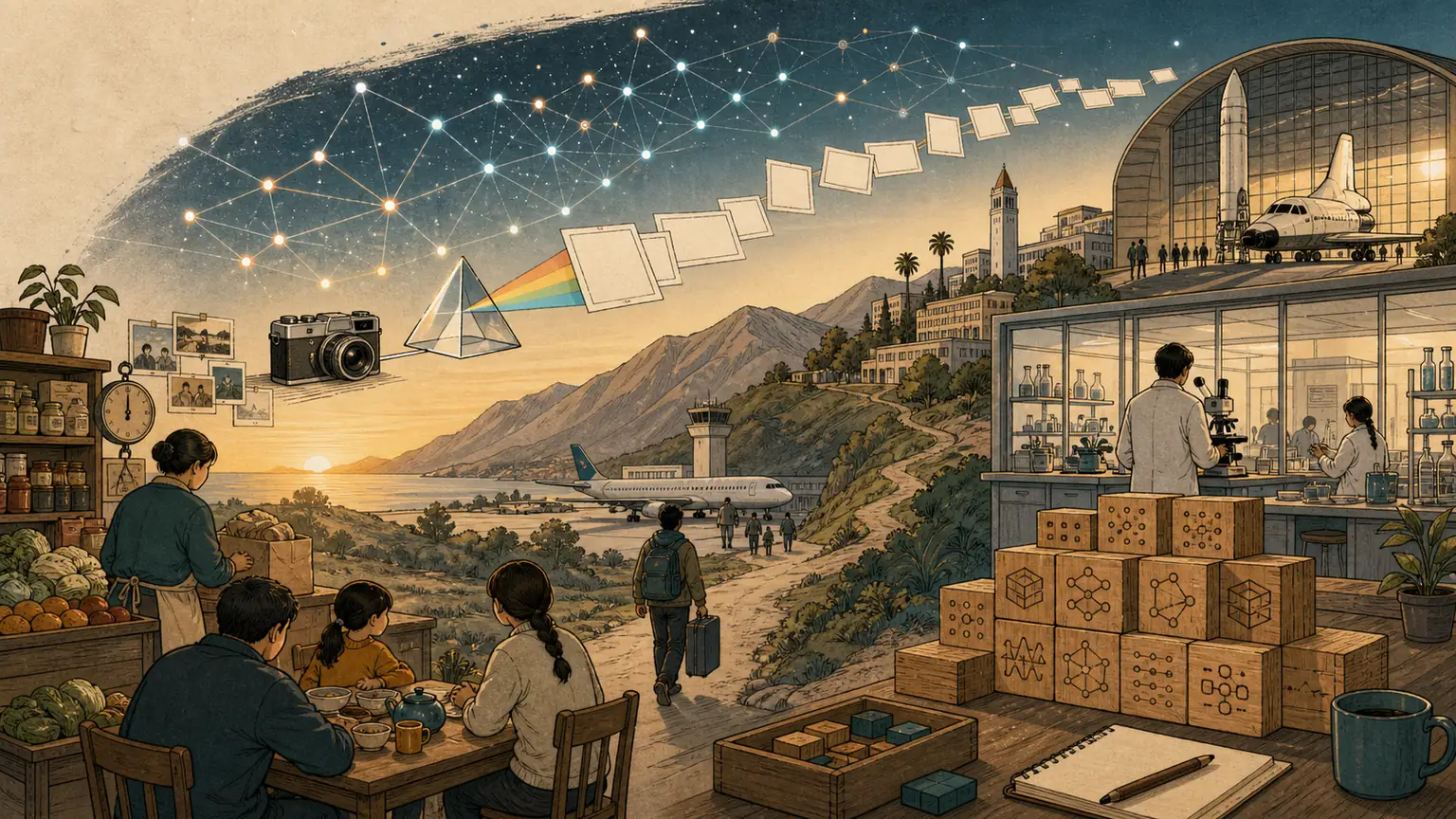
Algorithms, data, and compute. These are the three foundations of modern AI. Fei-Fei Li’s contribution to data alone is enough to secure her name and status. Many algorithms had already been prepared in advance, especially for computer vision. They were already ready in the 1990s. Compute only became ready in the last ten-plus years. I will read the Nvidia biography next year: https://book.douban.com/subject/37210122/
She places great importance on and feels great anxiety about her immigrant and female identities, even after so many years.
A typical Chinese immigrant family from the 1980s. The daughter is the pride of the family. She acts as the translator for medical staff and her mother.
Her thoughts jump around very quickly. This writing style, interweaving reality and the past, autobiography and AI history, feels very much like a movie. It may be adapted into one in the future. It would make such a good film, something like A Beautiful Mind. It is highly literary and beautifully written. No wonder I could not understand the English edition. Although I have read AI history in many places, and I worked on this during graduate school in Beijing, reading the AI history written by Fei-Fei Li moved me again. Human scientific progress is built brick by brick like this, with rises and falls; many discoveries lie dormant for years, then revive and advance again. Now, at the end of 2025, there is no doubt that AI, represented by large language models, is changing human civilization.
It is so moving as a representative story of the American Dream. I read it with tears in my eyes. It rekindled the American Dream. The last time a book made my eyes wet was Les Miserables, which I read in the first half of the year.
The final straw for immigration, the direct push, was unexpectedly that event in 1989.
Her mother was the daughter of a Kuomintang family, and therefore lost the opportunity to go to college. During the Cultural Revolution, she was also implicated.
In Chapter 11, her father talks about the past. Her grandfather died early in 1961; extreme malnutrition made his gastrointestinal disease impossible to endure. Her father was 14 at the time.
The reason both parents wanted to escape China was history and politics.
Chapter 2 writes about Newton isolating in the countryside during the plague and writing Philosophiæ Naturalis Principia Mathematica in Latin. Although the book’s main contributions were indeed born during Newton’s miracle year while isolating in the countryside in his early years, the book itself was written in middle age at Halley’s urging.
I was also a smart kid from childhood and often ranked first in my grade, but after reading about Fei-Fei Li, I realized that people like her are the real big brains. The part where she was admitted to Princeton with a full scholarship was truly moving.
Chapter 4, exploring the mind: quantity can bring qualitative change.
AlexNet really was the product of algorithms, compute, and data all becoming available. It came naturally, again reflecting how human progress is linked ring by ring.
The book begins with a House hearing, and the penultimate chapter ends with the same hearing. The structure is excellent. When encouraging Fei-Fei to go, her mother said, “The reason your father and I brought you to this country is that America gives you opportunities like this to reach and influence the government. And also the freedom to pursue the boldest dreams.”
The final chapter is about CS231n, the computer vision course. When I was in graduate school, I also watched the online course, though I did not keep up with it. It was produced very well, but unfortunately I was not interested and only followed the crowd in listening to it. Sure enough, I achieved nothing. It also talks about the latest large language models. Now in 2025, there is no doubt that LLMs are changing the world. As a programmer, the way I work is already completely different from the past.