Guns, Germs, and Steel: The Fates of Human Societies
YoungForest · https://youngforest.github.io/en/2024/01/08/Guns-Germs-and-Steel/
Douban link: Guns, Germs, and Steel: The Fates of Human Societies
Why is today’s international society the way it is? This is also the question asked in the book by Yali, a native farmer from New Guinea. Eurasia and the settler societies of Eurasians, such as North America and Australia, dominate. The proximate cause is the Age of Exploration that began in 1492: Europeans brought guns (and horses), germs, steel (various technologies), and advanced political systems such as states, opening the colonial era. Together with the Industrial Revolution in Western Europe, this laid the foundation for Western society’s leading position today. The later rising stars are East Asia (Japan, South Korea, China), South Asia (India), and Southeast Asia (Vietnam, Indonesia). Some have already become developed countries, while others are developing very quickly. Africa, especially sub-Saharan Africa, remains poor. These proximate causes are obvious and much discussed.
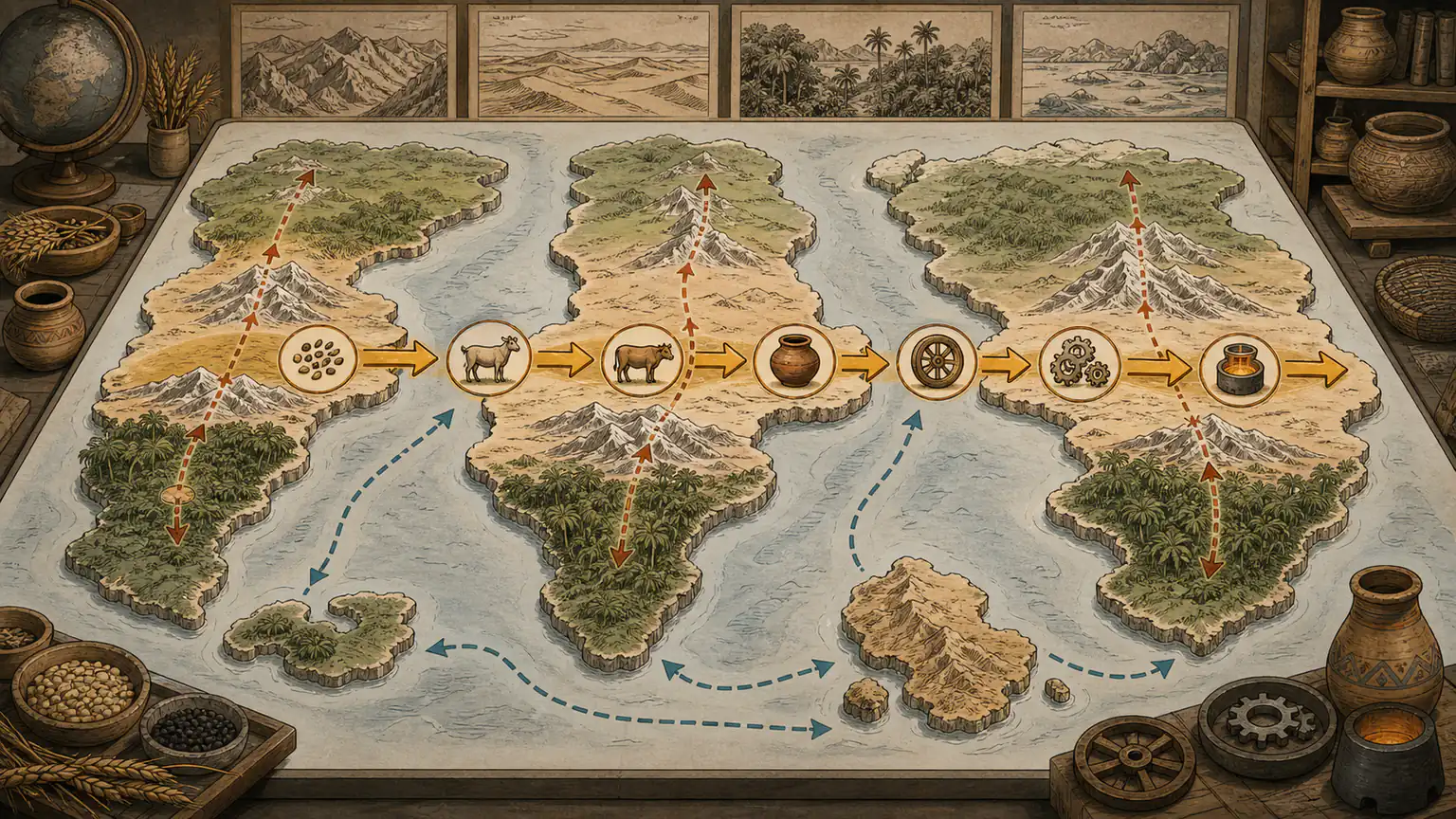
So what caused these proximate causes? The secondary proximate causes were the development of agriculture and technology, which led to population growth and made it possible to support non-farm specialists such as craftsmen, further promoting technological development and institutions such as bureaucracy and the state. The author is committed to tracing the ultimate causes: geography and the ecology closely related to geography. In other words, “geographic determinism”. 1. Environmental differences: each continent had different plant and animal resources available for domestication. 2. Eurasia’s axis is east-west, while Africa and the Americas are north-south, affecting the speed of diffusion and migration. 3. The spread of plants, livestock, and technology between continents. The Americas and Australia were relatively isolated from the rest of the world, sub-Saharan Africa was next, and China’s East Asia was also relatively independent within the Eurasian landmass. 4. Differences in the area and total population of each continent.
The author also discusses and refutes other scholars’ views, such as racial determinism, cultural determinism, and the great-man view of history.
I am grateful to have been born in China. Although it cannot compare with Western societies such as Western Europe, North America, and Australia, nor with developed East Asian regions such as Japan, South Korea, and Taiwan, at least it is far better than Africa. The birth lottery cannot be changed; the rest can only depend on one’s own immigration.