Thoughts on Netflix's The Three-Body Problem: Question Cheng Xin, Understand Cheng Xin, Become Cheng Xin
YoungForest · https://youngforest.github.io/en/2024/03/25/3-body/
Recently Netflix’s version of The Three-Body Problem has become popular, surrounded by both praise and criticism. I have not watched it, so I cannot really comment. But it did bring back my own memories with The Three-Body Problem.
As for the novels, I read them about ten years ago in the Shahe library. Although the series had not yet won the Hugo Award at the time, it was already slowly becoming popular. In my memory, the original title was something like Remembrance of Earth’s Past: The Three-Body Problem, The Dark Forest, and Death’s End. Although The Three-Body Problem is only the first book and also the name of the virtual reality game in it, because it became so popular, it gradually became the name people used for the whole series. The funny thing is that in the library, I could only borrow the first and third books. The second book was always impossible to reserve. So my reading order was: first, third, second. I also read Baoshu’s continuation, The Redemption of Time. My personal ranking of the three books is: Death’s End > The Dark Forest > The Three-Body Problem. That was also how I fell into the science fiction pit. After that, I read Liu Cixin’s other novels. I also encountered Asimov’s Foundation and Galactic Empire series, and the novella The End of Eternity. They are all excellent and recommended.
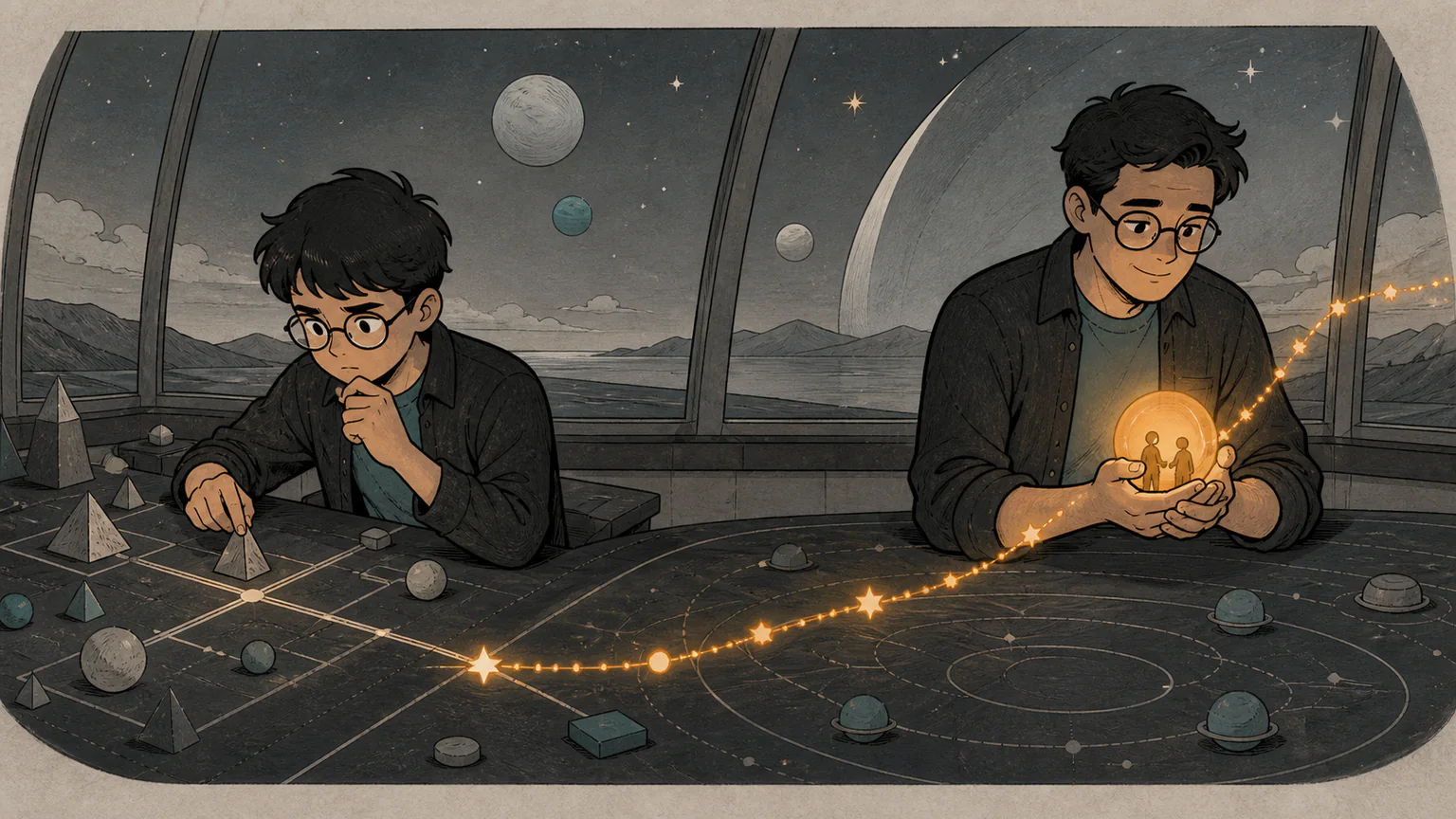
The most magical feeling is this: when I was less than twenty, after finishing the books, I worshiped Luo Ji, respected Wade, and looked down on Cheng Xin. Now, as I am approaching thirty, I find myself becoming more and more like Cheng Xin. I do not know whether it is because I have grown older or something else, but I have become increasingly gentle and kind toward others, the world, and humanity. Question Cheng Xin, understand Cheng Xin, become Cheng Xin. I also better understand some details in the books: why Luo Ji was willing to hand over the Swordholder power, even while knowing the consequences for himself and for humanity; why Zhang Beihai hesitated when carrying out dark forest action against friendly ships; why even Wade, whose deterrence degree was almost full, ultimately kept his promise and handed over power, even while foreseeing the consequences for himself and humanity. Humans are a combination of intelligence, emotion, and animal nature. Liu Cixin’s view is clearly that, for human survival, intelligence > animal nature > emotion. Wade’s line, “If we lose our humanity, we lose much; if we lose our bestial nature, we lose everything,” is very representative. But it is exactly this emotion that plays an important role at every critical moment, changing history and humanity’s fate. Of course, every time, it changes things toward catastrophe. Even so, humans still cannot escape the constraints of human nature. Even someone as strong as Wade ultimately could not remove all humanity and make decisions purely according to reason and animal nature.
As for the show, the most discussed part is probably the first episode. The famous line “Einstein says once there’s milk, that’s his mother” cannot be understood without knowing that period of history, the ten years of “arduous exploration.” Without that context, it is hard to understand how Ye Wenjie’s anti-human personality was shaped, and hard to understand her behavior and position, which is essentially the Adventist position. Although the show changed many things, this part did restore the original work and partially reflected history. Liu Cixin was actually already very restrained and implicit. Twenty years ago he could still write and publish it; now, probably not.