The Glory and the Dream: A Narrative History of America, 1932-1972
YoungForest · https://youngforest.github.io/en/2025/05/18/The-Glory-and-the-Dream/
The Glory and the Dream: A Narrative History of America, 1932-1972
Recommended by Luoji Siwei. The author’s left-wing tendency is quite serious: he beautifies the Democratic Party and demonizes the Republican Party. The writing is so beautiful that it is almost excessive. It reminds me of the Grand Historian, and I cannot help wondering whether it is also “half hearsay and half imagination.” Just kidding. I had just reached Roosevelt’s election in 1932. American history has gone through many challenges far greater than today’s. Roosevelt was also a person who changed America, moving it from liberalism toward statism, from isolationism toward globalism. It was also the moment in America’s 250-year history when it came closest to the risk of dictatorship. This is what happens in a crisis. Liberal democracy is hard-won and should be cherished. Today, on the news and across the internet, people are always worrying about America’s severe division, deglobalization, and the rise of the right. All I can say is: too young. Take history as a mirror. America is trustworthy.
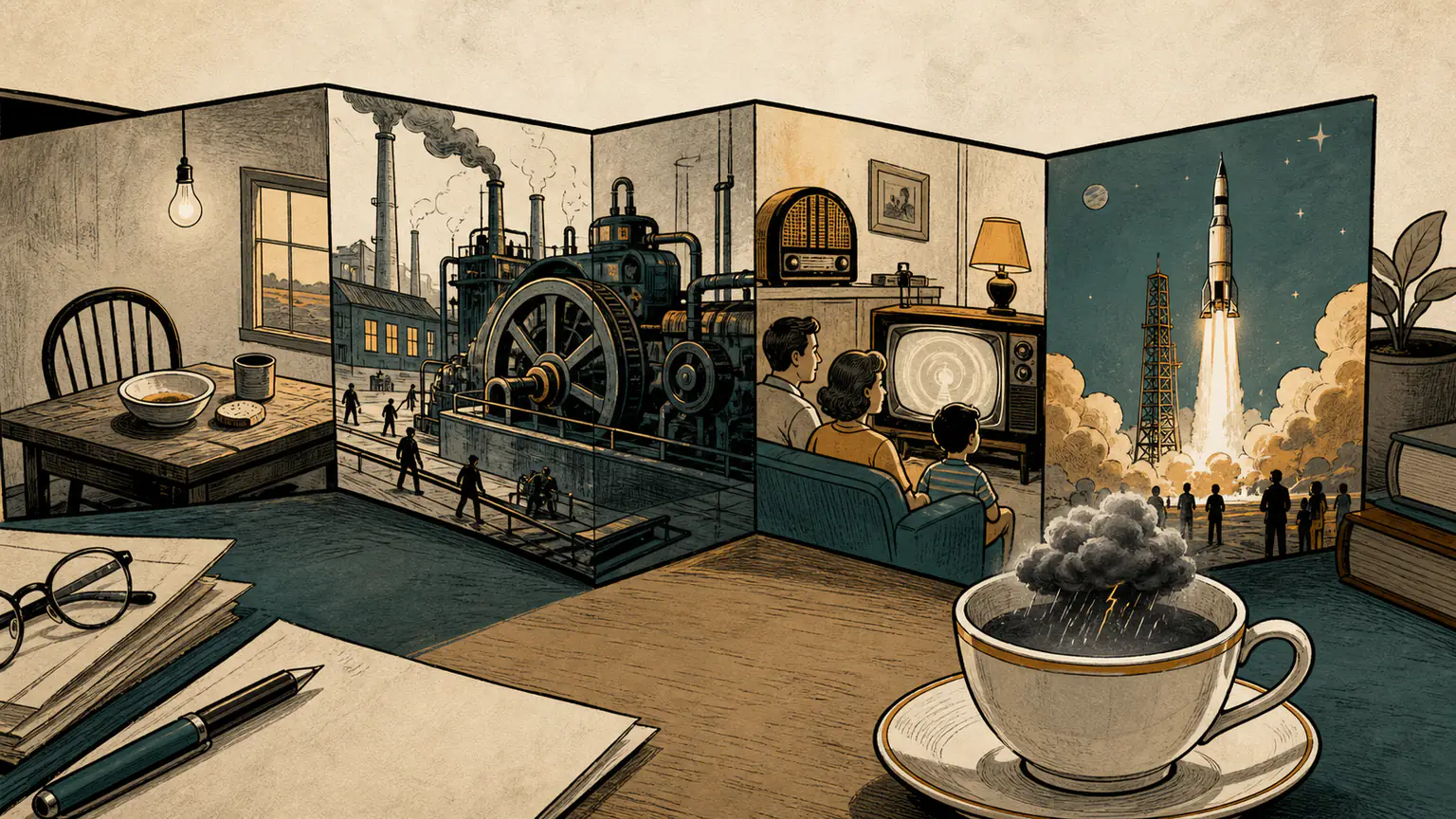
The whole book is a chronological account. For foreigners, many parts are passed over briefly and still feel quite unfamiliar. This is especially true of the history of entertainment and mass life. Those stars, films, and novels: I know none of them. It is a very long book, four thick volumes, the longest book I have finished this year. Another long book I am reading is Les Miserables, which I have not finished yet.
The writing is decent. Many historical scenes feel as if the author were watching from the side. The vividness is almost unbelievable. In this regard it is similar to Sima Qian. Of course, now there is an enormous amount of historical material; it is just that the author exaggerates a little.
The author leans heavily Democratic. Although it is understandable that intellectuals are left-wing, in a chronological history this feels a bit too forceful. The “Spring and Autumn brushwork” becomes hard to keep reading.
After finishing it, I became even more spiritually American. Look at all these ideologies, wars, party struggles, technological progress, and the enormous changes in media and mass life throughout history. Every decade is a major change. Then one will not be overly joyful or sorrowful about Trump, trade wars, local wars (Russia-Ukraine, Israel-Palestine, India-Pakistan), or temporary ups and downs in US stocks. These are small scenes. Compared with the past, today’s world is truly much better, especially for an IT practitioner. One flaw of intellectuals is that they always indulge in nostalgia and lament the present.
The government never participates in any productive activity. In essence it is parasitic, while economic development mainly depends on entrepreneurs who are willing to take capital risks for profit.
Extremists can always attract a few people. In 1861, only a minority in the American North were abolitionists; in 1776, only a minority of colonists truly yearned for territorial independence. The best barometer of a social group’s mood is the sympathy it receives, not the number of participants.
America is great not because of what the government has done for the people, but because of what the people have done for themselves.
As the afterword says, the true founding spirit of America is freedom.
If freedom is to have substantive meaning, its tolerance must be broader, and it must include protection for those condemned by thousands. Anyone can cheer for Eisenhower, MacArthur, John Glenn, and Neil Armstrong; but it takes some breadth of mind to tolerate the Weather Underground members who hated Lyndon Johnson, the John Birch Society members who opposed John F. Kennedy, and the Liberty League members who made trouble for Roosevelt.
America’s divisions and historical disgraces are many: … but those were always exceptions. If one were to list examples showing its spirit of tolerance, the list would be several times longer, enough to be regarded as an honor roll of the nation’s freedom fighters.
Last year’s election broke many left-wing intellectuals. They cried that American democracy was finished and developed “political depression.” But I instead think this is a sign that the American spirit remains strong. As Voltaire said, “I disapprove of what you say, but I will defend to the death your right to say it.” The Republican president and both chambers of Congress all won majorities. The Democratic Party can no longer blame the voters; otherwise it may lose the midterms too. Technological progress once again had a huge impact on the election: social media, podcasts, and the like. Just as radio once affected newspapers, television affected radio, and the internet affected television. Although everyone says America has never been so divided, looking across history, America has often been divided; unity is the minority state. The ending of the book, 1962-1972, is likewise dominated by division. Reading history makes one wise: take the present lightly and be optimistic about the future.