Business Cycles: History, Theory and Investment Reality
YoungForest · https://youngforest.github.io/en/2025/05/26/Business-cycles-history-theory-and-investment-reality/
The first 30% is especially interesting. Because it is ancient, full of stories and legend, and has relatively few figures, the economics is also easy for modern people to understand. After entering the post-Keynesian era, it becomes much harder. There are many figures, many schools, and many disagreements.
The most important core fact about the free market is that a transaction simply cannot happen unless both sides benefit.
Microeconomics is a science. Macroeconomics feels more like sociology. It is like the book I read before, Deep Simplicity: Chaos, Complexity and the Emergence of Life. Tiny changes in a system can bring incalculable effects.
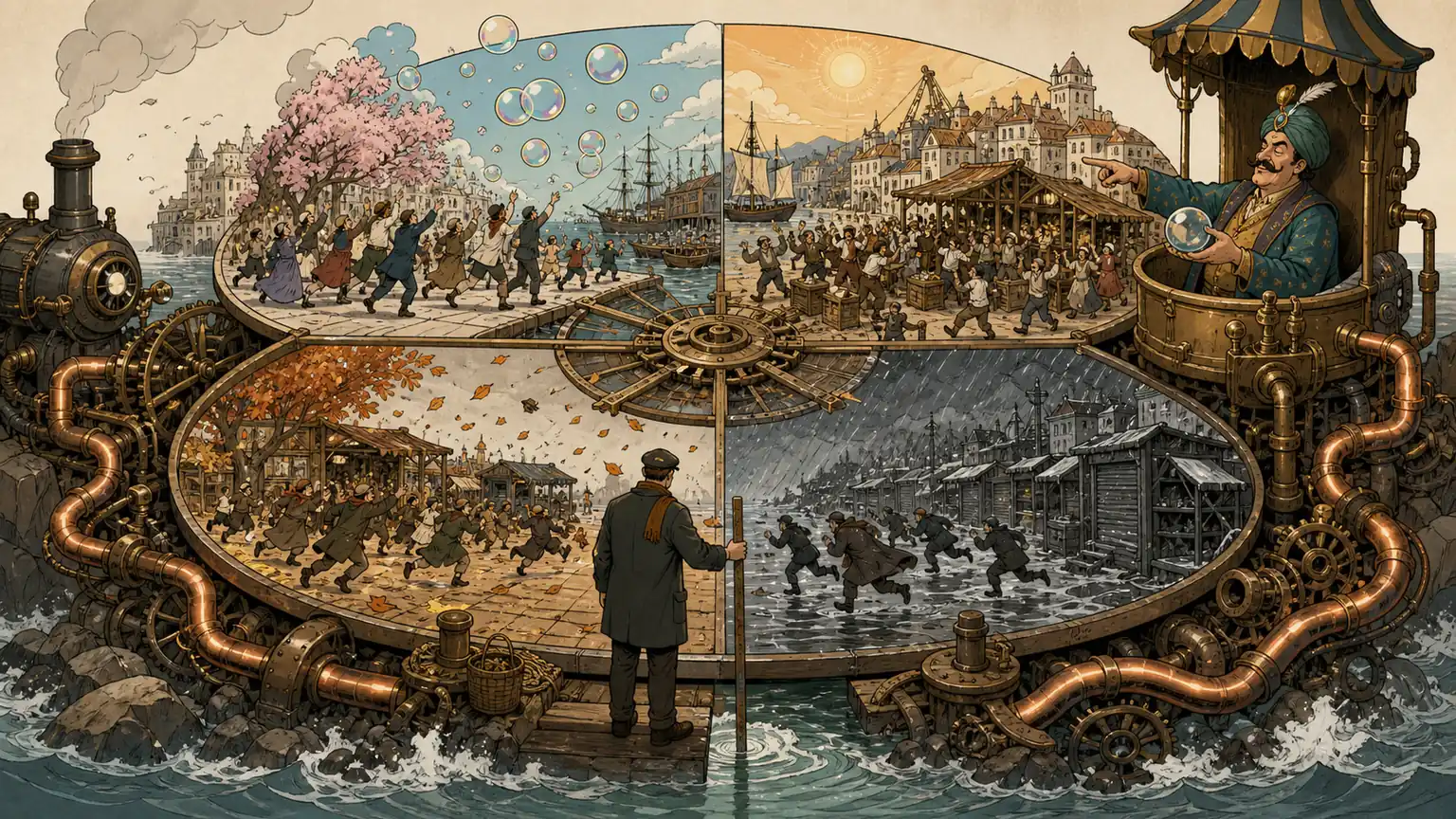
It is much easier to predict economic activity by studying the stock market than to predict the stock market by studying the economy.
Manias and crashes used to be associated with universal irrationality or mob psychology.
Sixteen psychological biases:
- Representativeness effect: we tend to believe that the trends we observe will continue.
- False consensus effect: we tend to overestimate how many people agree with what we see.
- Regret theory: we try to avoid actions that would confirm that we have already made a mistake.
- Anchoring / framing: our decisions are influenced by information that vaguely hints at the correct answer.
- Assimilation error: we misinterpret incoming information, believing it agrees with what we are doing.
- Selective acceptance: we accept only information that seems to agree with our actions and attitudes.
- Mental compartmentalization: we divide phenomena into different compartments and try to optimize each compartment separately rather than the whole.
- Selective perception: we distort information so that it agrees with our actions and attitudes.
- Overconfidence behavior: we overestimate our ability to make correct decisions.
- Hindsight bias: we overestimate how likely we were to predict the outcomes of a series of past events.
- Confirmation bias: our conclusions are improperly tilted toward what we want to believe.
- Adaptive attitudes: we often hold the same attitudes as people we know well.
- Social comparison: when facing a topic we find difficult to understand, we use other people’s behavior as a source of information.
- Cognitive dissonance: we try to avoid or distort evidence showing that our assumptions are wrong, and we also avoid emphasizing actions that create such dissonance.
- Ego-defensive function: we adjust our attitudes so that they appear to agree with the decisions we have made.
- Prospect theory: we have an irrational tendency to prefer gambling on losses rather than gambling on gains, which means we hold losing positions longer than winning positions.
Paul Volcker: people think inflation is a cruel tax, perhaps the cruelest tax, because it delivers unexpected blows to many sectors and harms people on fixed incomes the most.
Friedman: inflation is always and everywhere a monetary phenomenon. To control inflation, one only needs to control the money supply.
Schumpeter, 1939: cycles are not something like tonsils that can be removed separately. They are like the heartbeat, at the core of the organism.