Why Nations Fail: The Origins of Power, Prosperity, and Poverty
YoungForest · https://youngforest.github.io/en/2025/06/23/Why-Nations-fail/
Be sure to read the English edition or the Taiwanese translation; those who know, know. Although China is a classic case of a historically failed state and of a country where extractive institutions produced short-lived growth, the book actually does not spend that much space on it. But as a Chinese person, the cases from other countries are also worth studying, and I did not know much about them before, especially many cases from Africa and Latin America. Still, everywhere in my mind I was verifying China’s failure. Comparing the socialist education I received from the beginning, which was terrifying brainwashing plus rewritten history and politics, with the various history, economics, and political books I read after becoming an adult, I strongly agree with the book’s arguments. I myself am also voting with my feet. If time is limited, pay attention to these two sections.
Chapter 13, “Why Nations Fail Today”, section 5, “The New Absolutism”
It describes the extractive institutions of communism.
Chapter 15, “Understanding Prosperity and Poverty”, section 2, “The Irresistible Charm of Authoritarian Growth”
It explains why China’s growth cannot be sustained.
I once had high hopes for political reform in China, but now I have completely lost hope. I have run, I have run.
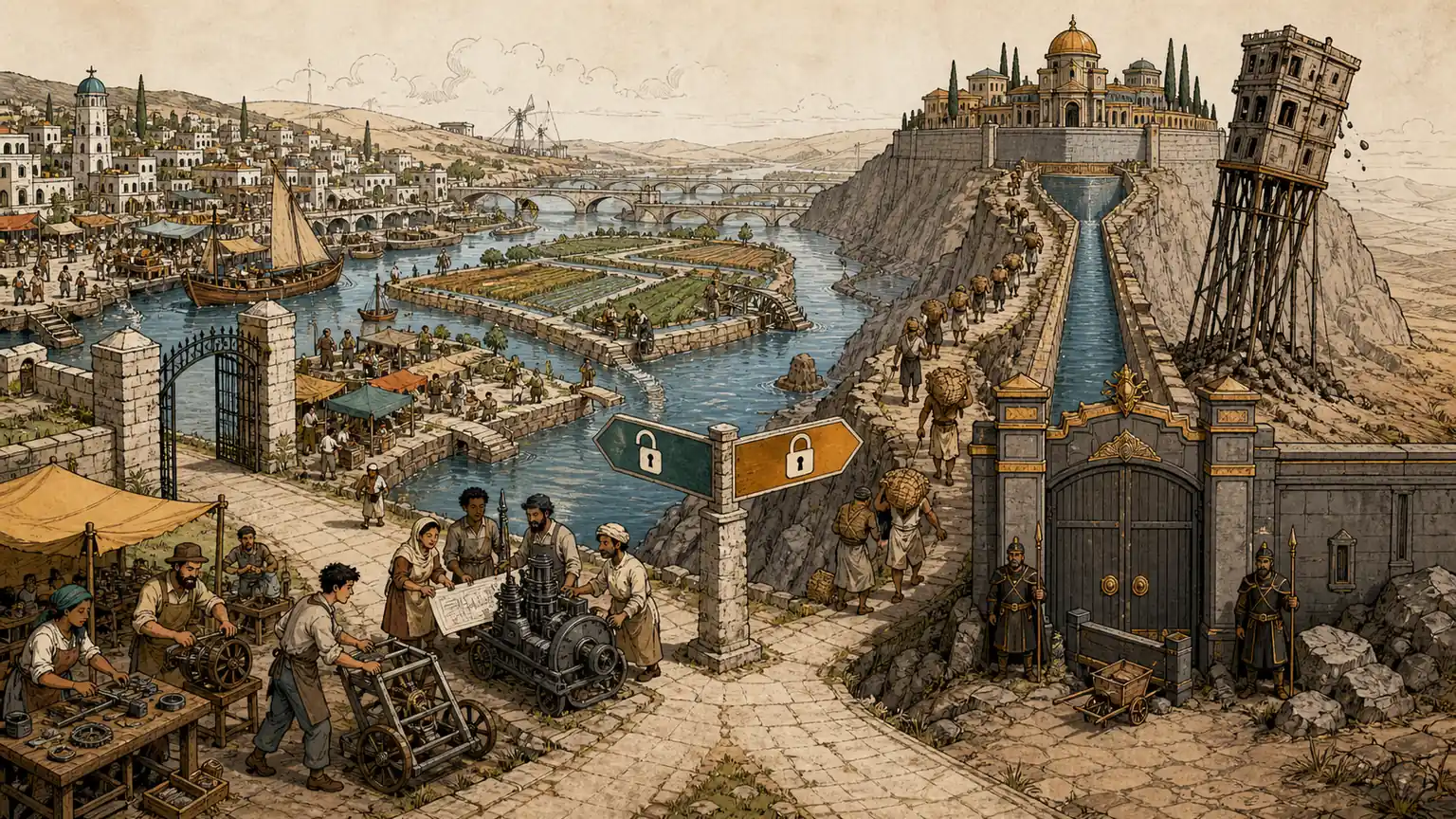
Inclusive economic and political institutions are necessary conditions for sustained growth.
Critical junctures, institutional drift, and similar forces determine institutional development.
The book does not support historical determinism. Although institutional change is based on prior institutional genes, and there are virtuous circles and vicious circles, it is also full of contingency.
Poverty is caused by institutions: 1. the lack of a centralized government, or 2. extractive economic and political institutions.
Sustained economic growth requires incentives and protections for broad groups of people. The key lies in what Schumpeter called “creative destruction”. This is also the fundamental reason extractive institutions obstruct sustained growth.
Even technological innovation does not necessarily increase agricultural output. In fact, we all know that when the Aboriginal Australians known as the Yir Yoront adopted the major technological innovation of steel axes, it did not make them work harder. Instead, they slept longer, because survival became easier and there was no incentive to work harder.
(This made me laugh so hard. Same as me.)
The rise of robber barons and trusts in the late nineteenth and early twentieth centuries fully illustrates one fact: markets themselves do not guarantee inclusive institutions.